


Pharmaceutical manufacturing requires much more than temperature control. Humidity can influence raw materials, production processes, packaging, storage, and the overall stability of a manufacturing environment. For this reason, an efficient dehumidifier for pharmaceutical industry applications is an important part of modern pharmaceutical facility design.
At the same time, pharmaceutical factories often need to maintain controlled environmental conditions for long operating hours. If a dehumidification system consumes excessive energy, operating costs can increase significantly. The challenge is therefore to maintain the required humidity level while using energy as efficiently as possible.
Modern desiccant technology, intelligent controls, optimized airflow, and customized system design can help pharmaceutical manufacturers achieve this balance. Dryair provides customized industrial dehumidification solutions designed for pharmaceutical production environments where stable humidity control and energy efficiency are both important.
Why Humidity Control Matters in Pharmaceutical Manufacturing
Moisture can affect pharmaceutical manufacturing in several ways. Some raw materials are moisture-sensitive and may absorb water from the surrounding air. Changes in moisture content can influence material handling, powder flow, processing performance, and storage stability.
High humidity can also create unfavorable conditions for packaging materials and equipment. In certain production areas, excessive moisture may contribute to condensation, corrosion, or other environmental problems.
A reliable pharmaceutical manufacturing humidity control system helps maintain a stable environment by continuously monitoring and managing moisture levels.
However, effective humidity control does not mean simply removing as much moisture as possible. The system should be designed around the actual requirements of each production area.
The Cost of Inefficient Dehumidification
Dehumidification can become a significant part of a pharmaceutical facility's energy consumption, especially when strict humidity conditions must be maintained continuously.
An inefficient system may consume more energy because of:
- Oversized equipment
- Poor airflow distribution
- Unnecessary over-drying
- Inefficient regeneration
- Excessive fresh-air loads
- Lack of automatic control
- Poorly designed ductwork
These problems can increase operating costs without necessarily improving production conditions.
This is why choosing an energy-efficient pharmaceutical dehumidifier should involve more than comparing equipment capacity. The complete system design has a major impact on long-term performance.
Desiccant Dehumidification for Pharmaceutical Facilities
Desiccant dehumidification is widely considered for pharmaceutical applications that require stable low-humidity conditions.
Unlike conventional refrigeration systems, desiccant systems use moisture-absorbing materials to remove water vapor directly from the air. A desiccant rotor continuously adsorbs moisture from process air, while a regeneration section removes the captured moisture and prepares the rotor for continued operation.
This technology can be particularly useful when pharmaceutical production requires low humidity or controlled dew point conditions.
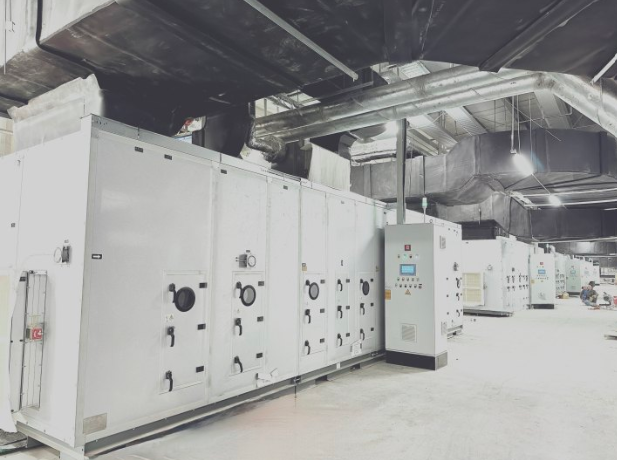
For example, a desiccant dehumidifier for pharmaceutical manufacturing can be integrated into a controlled air handling system to provide dry process air for specific production areas.
How Energy-Efficient Design Reduces Operating Costs
Energy efficiency depends on the entire dehumidification system rather than one individual component.
Match Capacity to Actual Moisture Load
A properly sized system can avoid unnecessary energy consumption. Engineers should consider room volume, outdoor air infiltration, door opening frequency, personnel movement, equipment loads, and production schedules.
Oversizing the system can increase initial investment and operating costs, while undersizing may make it difficult to maintain the target humidity.
Use Intelligent Humidity Control
Modern control systems can adjust dehumidification performance according to real-time humidity and dew point conditions.
Instead of continuously operating at maximum capacity, the system can respond to changes in moisture load.
This approach helps maintain stable conditions while avoiding unnecessary energy use.
Optimize Airflow
Efficient airflow is essential for pharmaceutical environmental control.
Poorly designed airflow may create areas with excessive humidity while other areas receive more dry air than necessary. Proper duct design, air distribution, and circulation can improve the effectiveness of the entire system.
Consider Heat Recovery
Depending on the system configuration, heat recovery can help reduce energy requirements associated with air treatment and desiccant regeneration.
When properly integrated, heat recovery can improve overall system efficiency without compromising humidity control.
Zoning for More Efficient Pharmaceutical Dehumidification
Not every room in a pharmaceutical facility needs the same humidity conditions.
Production rooms, packaging areas, raw material warehouses, corridors, and technical spaces may have different environmental requirements.
Creating separate environmental zones allows the dehumidification system to deliver the appropriate level of treatment to each area.
This is an important strategy for pharmaceutical facility dehumidification, because it prevents energy from being wasted on areas that do not require strict low-humidity conditions.
Zoning can also make it easier to monitor environmental conditions and identify areas with unusually high moisture loads.
Protecting Pharmaceutical Materials and Processes
Energy efficiency should never come at the expense of process stability.
A well-designed dehumidification system needs to maintain consistent conditions while minimizing unnecessary energy consumption.
Stable humidity can help protect moisture-sensitive raw materials and support consistent processing conditions. It can also help reduce moisture-related problems during packaging and storage.
For pharmaceutical manufacturers, this balance between environmental control and energy efficiency is important for maintaining reliable production over the long term.
Dryair Pharmaceutical Dehumidification Solutions
Dryair develops customized dehumidification solutions for pharmaceutical manufacturing facilities and other controlled production environments.
Rather than using the same equipment configuration for every project, Dryair considers the specific requirements of each facility, including:
- Required humidity level
- Target dew point
- Room volume
- Moisture load
- Outdoor climate
- Airflow requirements
- Production schedule
- Energy consumption targets
Dryair solutions can incorporate desiccant dehumidification, intelligent control, dew point monitoring, optimized airflow, and other air treatment technologies.
For new pharmaceutical facilities, Dryair can support system planning and engineering design from the early project stage. For existing facilities, customized upgrades can help improve dehumidification efficiency and environmental stability.
Applications in Pharmaceutical Production
Energy-efficient pharmaceutical dehumidification can be used in different areas of a manufacturing facility, including:
Raw Material Storage
Humidity control helps protect moisture-sensitive pharmaceutical ingredients and packaging materials during storage.
Production Areas
Controlled humidity supports stable manufacturing conditions and helps reduce moisture-related process variations.
Packaging Areas
Stable environmental conditions can help protect products and packaging materials during filling, sealing, and other packaging operations.
Finished Product Storage
Appropriate humidity management can support suitable storage conditions and reduce moisture-related risks.
What to Consider When Selecting a Pharmaceutical Dehumidifier
Before purchasing a dehumidifier for pharmaceutical industry applications, manufacturers should evaluate the complete operating environment.
Important factors include:
- Required relative humidity
- Required dew point
- Room dimensions
- Moisture generation sources
- Outdoor climate
- Air change rate
- Energy efficiency
- Control system capabilities
- Maintenance requirements
- Future production expansion
A professional engineering assessment can help determine the appropriate technology and capacity instead of relying only on nominal equipment specifications.
Conclusion
An energy-efficient dehumidifier for pharmaceutical industry production facilities can help manufacturers manage humidity while controlling long-term operating costs. Desiccant technology, intelligent controls, optimized airflow, zoning, and accurate system sizing can all contribute to better energy performance.
For pharmaceutical manufacturers, the best solution is not necessarily the largest dehumidifier. It is a system designed around the actual moisture load, production process, environmental requirements, and future operating conditions.
With customized Dryair pharmaceutical dehumidification solutions, manufacturers can establish stable humidity control while improving energy efficiency and supporting reliable production.
Post time: Sep-01-2026